Chocolate Delivery Temperature Review
A package can experience temperatures above the outdoor air during delivery. Here’s an illustrative look at what that could mean for chocolate in December.
Delivery temperatures and December scenarios
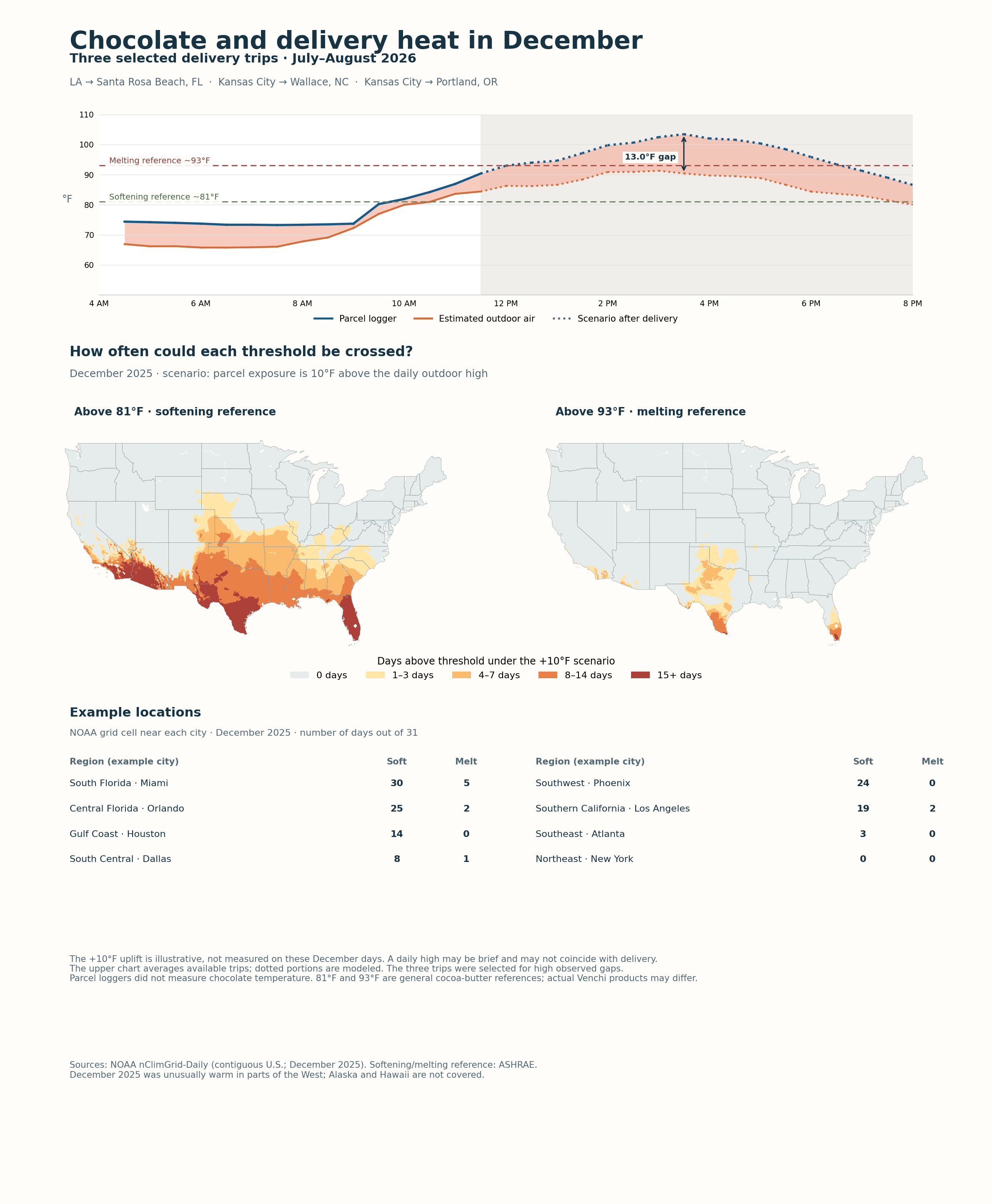
Three selected delivery trips show the relationship between parcel-logger and estimated outdoor temperatures. The maps use a separate December weather scenario to illustrate where heat exposure could matter.
How to read the chart and maps
Solid lines show averages of available parcel-logger readings and estimated outdoor air; dotted lines extend past delivery using an illustrative model. The three trips were selected for larger observed gaps and are not a representative sample.
The loggers measured parcel exposure, not chocolate temperature. The maps use December 2025 outdoor daily highs plus an illustrative 10°F—not temperatures measured on those December days. Actual conditions and Venchi products may behave differently.
What the December scenario shows
The maps add an illustrative 10°F to each day’s outdoor high. They count days above 81°F and 93°F, general cocoa-butter softening and melting references. These are not measured vehicle or chocolate temperatures, and Venchi products may behave differently.
| Example location | Above 81°F | Above 93°F |
|---|---|---|
| Miami, FL | 30 days | 5 days |
| Orlando, FL | 25 days | 2 days |
| Houston, TX | 14 days | 0 days |
| Dallas, TX | 8 days | 1 day |
| Phoenix, AZ | 24 days | 0 days |
| Los Angeles, CA | 19 days | 2 days |
| Atlanta, GA | 3 days | 0 days |
| New York, NY | 0 days | 0 days |
Counts are out of 31 days, based on the NOAA grid cell near each city in December 2025. The daily high may be brief and may not coincide with delivery. December 2025 was unusually warm in parts of the West; the maps cover the contiguous U.S. only.
Ice packs don’t stop when summer ends
Chocolate brands continue using cold protection in cooler months for warm destinations or when temperatures rise.
| Brand | Cooler-month destinations or trigger | Protection |
|---|---|---|
| Alter Eco Source ↗ | Year-round: Arizona, Florida, Hawaii and Texas | Ice packs for orders containing chocolate |
| EHChocolatier Source ↗ | Year-round: warm climates, including Arizona, Texas, Florida and Southern California | Insulated lining and ice packs |
| Betsy Ann Chocolates Source ↗ | Year-round: Southern California, Arizona, Southern Texas, Louisiana and Florida | Insulated container and ice packs; warm-weather fee applies |
| Jacques Torres Chocolate Source ↗ | 70°F or warmer at the destination city triggers its warm-weather shipping guidance | Its corporate policy says it provides a Styrofoam-lined container and ice packs, and asks customers to choose two-day or overnight shipping |
| Lake Champlain Chocolates Source ↗ | Year-round: warm-weather destinations. No cities specified. | Insulated liners and gel ice packs; checks weather along the route |
| Neuhaus Source ↗ | Cold-weather shipments: destinations in warmer regions. No cities specified. | Insulated liners and ice packs |
EHChocolatier’s list is not exhaustive. Betsy Ann does not define its southern regions by city.
These are each brand’s published shipping practices, reviewed November 2026—not tested limits for Venchi products or proof that one packaging configuration works for every route. Actual protection should be validated against the product, packaging, transit time and conditions.
NOAA nClimGrid-Daily · December 2025 daily maximum temperatures. ASHRAE Refrigeration Handbook · cocoa-butter softening and melting references.